
Data has become one of the most valuable business assets in the modern economy. Organizations generate massive amounts of information from customers, operations, finance, supply chains, manufacturing systems, and digital platforms every day.
However, collecting data alone does not create value. The real advantage comes from transforming raw data into actionable insights that support strategic decision-making.
This is where Business Intelligence Software plays a critical role. Modern BI platforms help organizations collect, analyze, visualize, and interpret business data to improve performance, reduce costs, identify opportunities, and drive growth.
For enterprises across the United States, Canada, Germany, Australia, Switzerland, the United Kingdom, Netherlands, France, Belgium, Italy, Spain, Poland, Romania, South Africa, Brazil, Mexico, and Greece, business intelligence has become a core component of digital transformation strategies.
What Is Business Intelligence Software?
Business Intelligence Software is a technology solution that collects, processes, and analyzes business data from multiple sources.
The software helps organizations analyze operational performance, monitor KPIs, generate reports, forecast business trends, improve decision-making, identify growth opportunities, and reduce operational risks.
Modern BI platforms integrate artificial intelligence, predictive analytics, cloud computing, and machine learning capabilities to deliver deeper business insights.
Why Business Intelligence Is Important
Organizations today face challenges such as increasing data volumes, market competition, rising operational costs, complex reporting requirements, and regulatory compliance obligations. Business Intelligence Software helps bridge this gap by providing real-time visibility into organizational performance.
Key Benefits of Business Intelligence Software
1. Improved Decision-Making
Business Intelligence Software provides real-time dashboards, KPI tracking, executive reporting, and data visualization for faster and more informed business decisions.
2. Better Operational Efficiency
Data analytics platforms help organizations identify inefficiencies, reduce costs, improve workflows, optimize resources, and increase productivity.
3. Enhanced Financial Performance
Financial analytics software enables organizations to monitor revenue growth, profit margins, cash flow trends, and budget performance.
4. Predictive Business Forecasting
Predictive Analytics Software allows organizations to forecast customer demand, market trends, sales performance, and financial risks.
Core Features of Enterprise Business Intelligence Software
Data Integration
Modern BI platforms connect data from ERP Software, CRM Systems, Financial Applications, Manufacturing Systems, and Cloud Platforms.
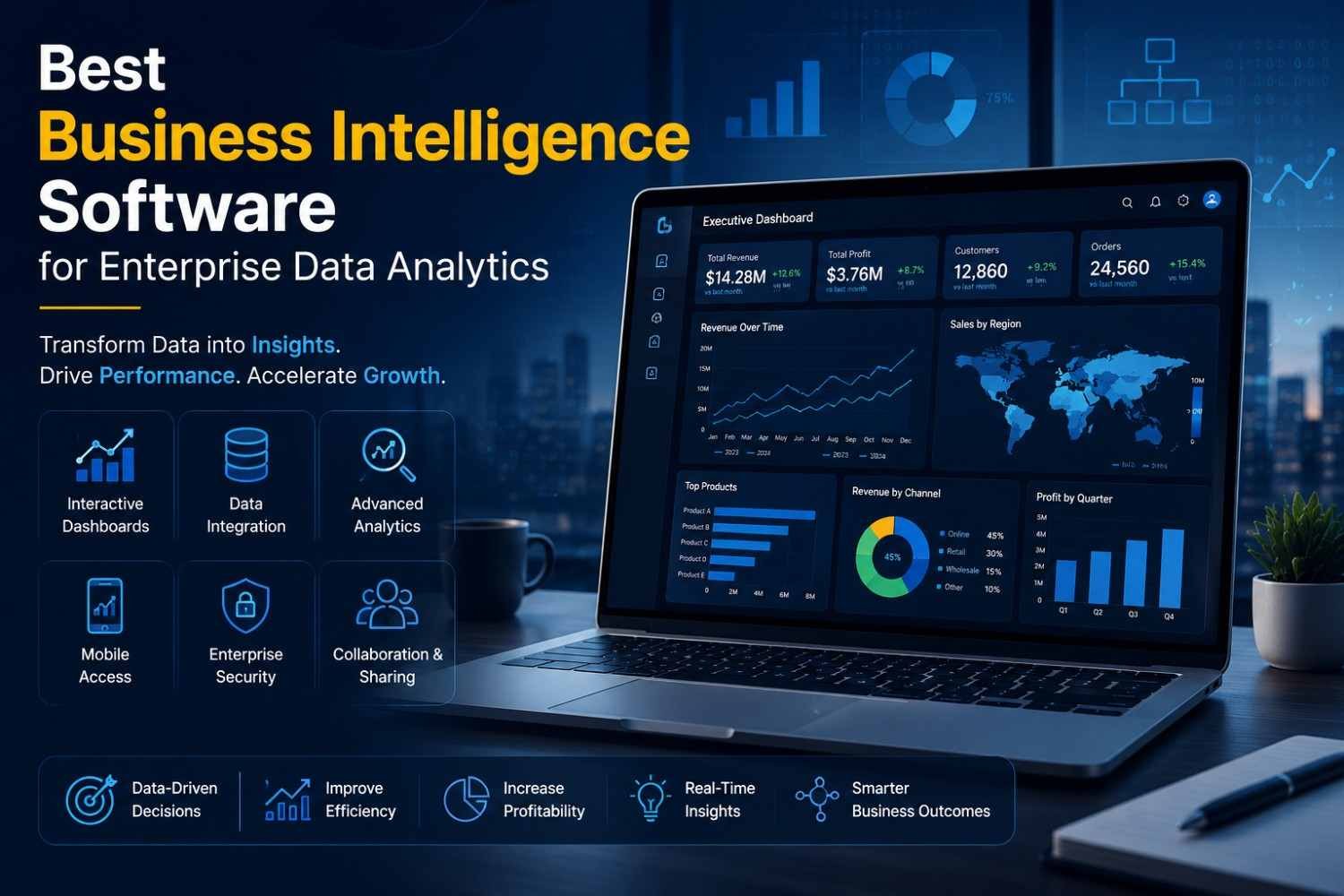
Interactive Dashboards
Dashboards provide visual insights into sales performance, financial KPIs, operational metrics, and customer behavior.
Advanced Reporting
Business Reporting Software enables organizations to generate executive reports, financial reports, operational summaries, and compliance documentation.
AI-Powered Analytics
AI-powered analytics platforms can detect patterns, identify anomalies, forecast outcomes, and generate recommendations.
Cloud-Based Business Intelligence Software
Cloud-based analytics platforms offer scalability, accessibility, lower infrastructure costs, and automatic updates.
Business Intelligence Trends for 2026
- AI Analytics Expansion
- Self-Service Analytics
- Real-Time Data Analytics
- ESG and Sustainability Analytics
- Cloud-Native BI Platforms
Frequently Asked Questions
What is Business Intelligence Software?
Business Intelligence Software helps organizations analyze data, generate reports, and make informed business decisions.
Why is BI important?
BI improves visibility, operational efficiency, financial performance, and strategic planning.
What is Predictive Analytics Software?
Predictive analytics software uses historical and real-time data to forecast future outcomes.
Conclusion
Business Intelligence Software has become one of the most important enterprise technologies for organizations seeking competitive advantages through data-driven decision-making.
By combining enterprise analytics, predictive analytics, financial reporting, AI-powered insights, compliance monitoring, and cloud-based scalability, modern BI platforms help organizations transform raw data into business value.
As enterprises continue investing in digital transformation initiatives, Business Intelligence Software will remain a critical technology category throughout 2026 and beyond.